
Last updated November 15, 2026
 Wrought iron
 Wood & steel frame
 Farm & ranch
 Sliding driveway gates
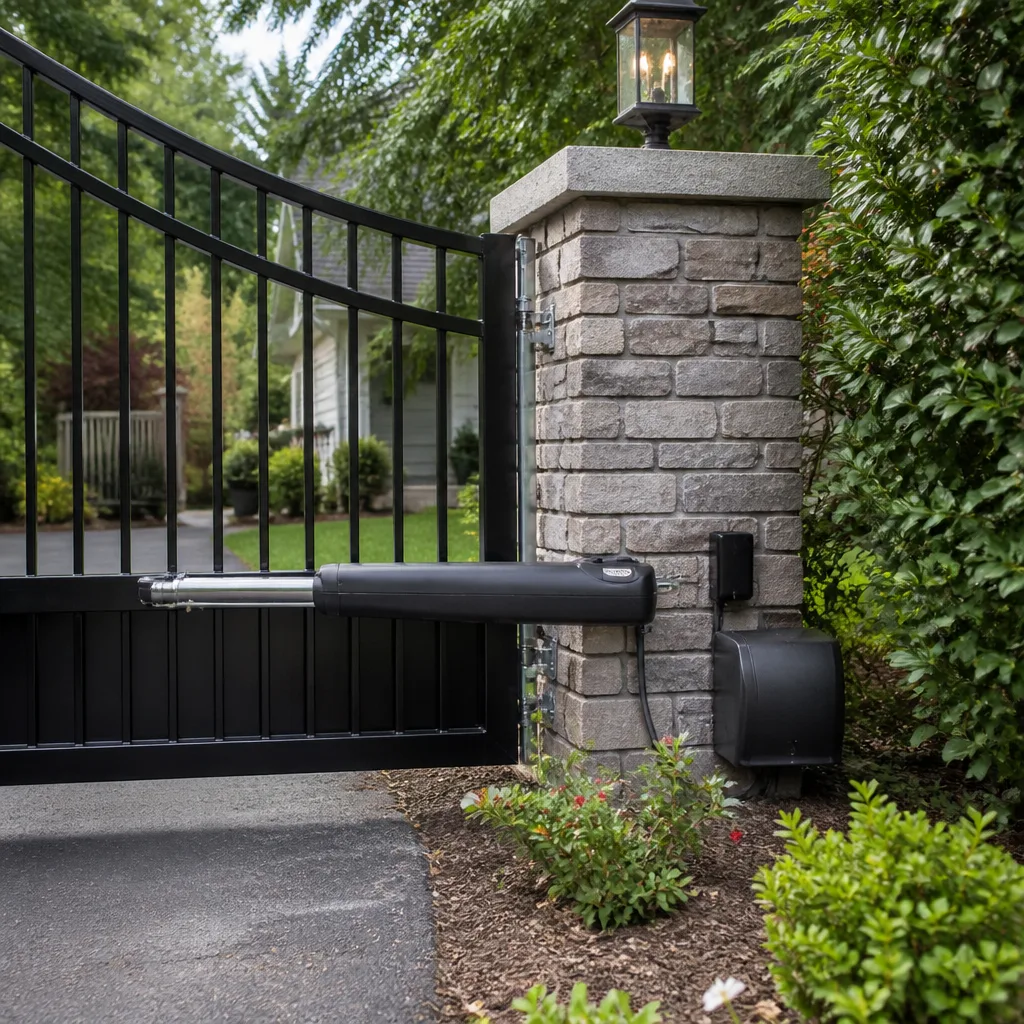 LiftMaster operators
Free on-site gate assessment - hinges, posts, and your LiftMaster or Nice gate operator checked before anything is quoted
The assessment is free and the quote is the invoice.
Get your free estimateDIY vs Professional Gate Repair: The Renton Homeowner’s Decision Guide
Resetting a gate operator after a power surge is legitimate DIY territory. Adjusting limit switches without understanding how your specific control board stores position memory is not – and the difference between those two jobs isn’t obvious until it’s already expensive. Most gate repair decisions get framed as a skill question: are you handy enough? That’s the wrong filter. The better question is whether the failure sits on the mechanical side of your gate or the electrical and operator side. This guide draws that line by failure type, with a DIY viability rating for each, so Renton homeowners can decide based on what actually broke rather than how confident they feel with a wrench.
Quick Answer
Mechanical gate problems – sagging hinges, worn rollers, a latch that won’t catch, a track with debris in it – are often reasonable DIY fixes. Electrical and operator-side failures, including control boards, limit switches, safety sensors, loop detectors and motor assemblies, are where DIY attempts most often cause cascading damage that costs more to undo than the original repair would have. If you can’t identify which side of that line your gate is on, that’s the signal to bring in a technician. We answer 24/7 at (866) 293-5161, and estimates are free.
Styles & brands we work with
- Wrought iron
- Wood & steel frame
- Farm & ranch
- Sliding driveway gates
- LiftMaster operators
Table of Contents
- Mechanical vs Electrical: The Line That Decides Everything
- The Failure-Type Decision Tree
- Which DIY Repairs Void Operator Warranties
- UL 325 Safety Reversing and the Liability Question
- What Tools and Knowledge You Actually Need
- The Real Cost of a Failed DIY Attempt
- Renton-Specific Factors That Change the Answer
- Common Mistakes to Avoid
Mechanical vs Electrical: The Line That Decides Everything
Every gate failure falls into one of two families, and the two families have almost nothing in common in terms of DIY risk. Mechanical failures involve physical hardware: hinges, rollers, wheels, tracks, latches, chains, and the gate panel itself. Electrical failures involve the operator, the power supply, the control board, the safety devices, and the wiring that connects them.
Here’s why the distinction matters more than raw skill. A mechanical repair that goes slightly wrong usually leaves the gate in roughly the same condition it started in – maybe a hinge is still loose, maybe a roller still binds. You haven’t lost much. An electrical repair that goes wrong can leave the operator in a worse state than the original fault, because control boards store configuration data, cycle counts, and learned positions that don’t survive a mistaken reset. We’ve seen this pattern repeatedly across LiftMaster and Linear residential operators in Renton: a homeowner follows a tutorial meant for a different board revision, the gate doesn’t move, and the eventual professional visit involves reprogramming from scratch rather than a simple sensor adjustment.
- Mechanical failures: physical wear, alignment drift, debris, loose fasteners, bent components. Generally observable and generally reversible.
- Electrical failures: no power, operator won’t respond, board faults, sensor misreads, motor stalls, loop detector issues. Often invisible and frequently not reversible without the right equipment.
If you can see the problem with your own eyes and touch it with your hands, DIY is on the table. If you need a multimeter to confirm what’s happening, the calculation changes. For the electrical side specifically, our electric gate repair service exists because that’s where most of the damage happens.
The Failure-Type Decision Tree
This is the core of the guide. Work through the categories below, find the one that matches your gate’s behavior, and read the DIY viability rating. The rating isn’t about whether you’re capable; it’s about whether an attempt is likely to make things worse if it doesn’t work.
1. Mechanical Hardware
Hinges, rollers, wheels, tracks, latches, and physical alignment. DIY viability: High for inspection and minor adjustment, moderate for replacement. You can usually see exactly what’s worn. Lubrication, debris clearing, and tightening fasteners are low-risk. Swapping a roller or a hinge is achievable if you match the part correctly and support the gate panel while you work. The main risk is a heavy panel shifting during the job, which is a crush hazard on swing gates especially.
2. Electrical Power
The gate has no power, trips a breaker, or the operator is completely dead. DIY viability: Low. Confirming that power reaches the operator is fine. Anything past that – opening a control enclosure, tracing a circuit, testing a transformer – moves into territory that requires a meter, an understanding of the wiring diagram, and an awareness of what’s live. This is also where we most often find that a “dead operator” was actually a tripped breaker or a failed low-voltage transformer that a proper diagnosis would have caught in minutes.
3. Controller / Board
The gate moves erratically, stops mid-travel, reverses for no reason, or won’t accept commands. DIY viability: Very low. This is the category where DIY causes the most expensive damage. Boards store learned limits, cycle counts, and configuration. A full factory reset performed without knowing what it wipes can erase settings that take a trained technician time to re-establish. If your operator is a FAAC or BFT unit with a board that isn’t documented clearly online, the risk climbs further.
4. Safety Sensor
The gate reverses on closing, stops short, or won’t close at all despite nothing being in the way. DIY viability: Low to moderate, with a hard limit. You can and should clear obstructions and check for visible damage. You can realign a photo-eye that’s been knocked out of position. What you shouldn’t do is bypass, disable, or “trick” a safety device to get the gate moving again, because that removes the exact protection that keeps someone from being crushed.
5. Structural
A post is leaning, a slide gate has come off its track, the gate frame is bent or cracked. DIY viability: Very low. Structural problems usually mean the gate has moved from its intended position, and correcting that means working with weight that can crush. A slide gate that’s jumped its track is a genuine hazard to move. This is professional territory, every time.
If you’ve landed on categories three, four, or five and you’re not sure, that’s the moment to call. The gate repair page covers how a diagnostic visit works.
Which DIY Repairs Void Operator Warranties
If your operator is still under manufacturer coverage, the DIY calculation changes completely. Certain interventions are the ones manufacturers treat as evidence of unauthorized tampering, and once that’s noted, warranty coverage on the operator can be refused regardless of what actually failed.
- Opening the control enclosure on a sealed unit. Many operators have enclosure seals or tamper indicators. Breaking one is the clearest possible signal that someone other than a technician has been inside.
- Replacing a control board or motor without authorization. Even a correctly installed board can void coverage if the part wasn’t sourced through the manufacturer’s channel.
- Resetting or reprogramming the controller. A factory reset that wipes stored configuration can be read in the operator’s own fault log, which technicians check.
- Disabling or bypassing safety devices. This voids coverage on nearly every operator made, and for good reason.
- Cutting or splicing operator wiring. Any alteration to the factory harness is treated as owner modification.
The practical rule: if your gate operator is still under coverage, any repair that involves opening the operator’s enclosure should go to a technician. The savings from a DIY fix are small compared to losing coverage on a board or motor assembly. If your operator is well out of coverage, the calculation is different, but the cascading-damage risk from a failed attempt doesn’t change.
UL 325 Safety Reversing and the Liability Question
UL 325 is the safety standard that governs automated gate operators, and the part of it that matters most for DIY decisions is the requirement for safety reversing. An automated gate must detect an obstruction in its path and reverse or stop. On modern operators this is handled by photo-eyes, edge sensors, or loop detectors, depending on the gate type and how it was set up.
Here’s the liability angle that tutorials tend to skip. If you adjust, move, or replace a safety device yourself and get the alignment slightly wrong, the gate may appear to work normally right up until it doesn’t detect something. If the gate then injures someone, the fact that the safety system was modified by a non-professional becomes a serious problem, whether that’s a family member, a delivery driver, or a visitor. That’s not a reason to be paralyzed; it’s a reason to treat safety-system work as different from adjusting a hinge.
In practical terms:
- Never disable or bypass a safety device to get a gate working. Fix the cause instead.
- If a safety device has been physically knocked out of alignment, photograph its position before adjusting anything.
- If the gate reverses for no visible reason, a professional diagnostic is the safe path, because the fault is likely in the sensor logic rather than the sensor itself.
This is also why we don’t walk homeowners through reconfiguring an operator over the phone. We’ll talk through the symptom to narrow down what’s failed, and if the fix involves the safety circuit, it needs to happen on-site. You can reach us at (866) 293-5161. We answer 24/7, and a call outside dispatch hours is booked into the next opening, Sunday through Friday, 7am to 7pm.
What Tools and Knowledge You Actually Need
Most gate repair tutorials skip the baseline: the tools and the background knowledge that separate a plausible attempt from a wasted afternoon. Here’s a realistic list of what a technician brings, broken down so you can judge whether you’re equipped.
Tools for mechanical work
- Wrenches and sockets sized to your specific gate hardware
- Lubricant appropriate for the gate’s moving parts (not WD-40 on everything)
- Blocks or supports rated for the gate panel’s weight
- Safety glasses and gloves, because a panel with a failed hinge can shift suddenly
- A level for checking rail and post alignment
Tools for electrical work
- A multimeter, and the knowledge to read it safely around live components
- The operator’s installation manual, including the wiring diagram for your exact model
- An understanding of how your specific board stores limits and cycle counts
- The ability to read a fault code and know what it means for that brand
The gap that trips people up isn’t tools – it’s the brand-specific knowledge. Knowing how a Linear board behaves after a reset, or how a LiftMaster operator stores position memory, is not the sort of thing that transfers from a generic video to your specific unit. In our experience, that’s where most of the cascading damage we work on comes from. For more on Gate Repair Renton and the diagnostics we run, start there.
The Real Cost of a Failed DIY Attempt
Here’s the calculation most homeowners do wrong. They compare the cost of a professional repair to the cost of doing it themselves, which is usually just parts and time. But the comparison that matters is the cost of a professional repair versus the cost of a failed DIY attempt followed by a professional repair.
A failed mechanical attempt usually costs you the part you bought and some time. The professional repair is roughly the same as it would have been, plus possibly a bit of rework. A failed electrical attempt is different. If a board gets bricked or a configuration gets wiped, the professional visit can involve a board replacement or a full reprogram that would never have been needed if you’d started with a diagnostic.
| Failure type | Typical DIY downside if it fails |
|---|---|
| Mechanical hardware | Cost of the failed part plus rework on the original repair |
| Electrical power | Time wasted on the wrong diagnosis; risk of creating a new fault |
| Controller / board | Reprogramming time, or a board replacement if the original is damaged |
| Safety sensor | Re-alignment visit, plus liability exposure if a device was bypassed |
| Structural | Risk of injury; potential for a rescheduled professional repair |
The pattern is consistent: the further a failure sits from the mechanical side, the worse the cost of a failed DIY attempt relative to the original repair. If you’re still uncertain where your gate falls, a free estimate gives you a straight answer before you spend anything on parts. Call (866) 293-5161. We answer 24/7. Fast dispatch from 7am to 7pm, Sunday through Friday.
Renton-Specific Factors That Change the Answer
Renton gate owners navigate some conditions that push certain repairs toward the professional side faster than they would in a drier climate or flatter terrain. Local context matters for the decision tree above.
Slope and grade. Many Renton properties sit on graded lots where swing gates run on a slope or where slide gates meet a driveway that isn’t perfectly flat. A gate that has to move on a slope puts more wear on hinges and operators than one on level ground, and it makes “just tighten the hinge” a less obvious fix because the underlying geometry is working against you. If a gate on a slope starts dragging or slowing, the cause is often cumulative wear rather than a single loose fastener.
Rain and seasonal moisture. The typical wet months in Renton drive rot in wooden gate frames, rust in steel hardware, and moisture infiltration into operator enclosures. That means some “electrical faults” are actually moisture-driven corrosion on connectors, which requires diagnosis rather than a reset. If your gate behaves differently after a stretch of rain, that’s a strong signal the fault is on the electrical side and needs an on-site look.
Tree cover and debris. Leaf litter and small branches are constant sources of track and roller problems in neighborhoods with mature trees. Most of that is genuinely DIY-clearing territory – which is why the mechanical category rates high.
Working across the city. Whether a gate is in a residential pocket of Renton or on a small commercial property, the failure types map the same way. Our specialization means we already know the behavior of the operators most common here, from residential LiftMaster and Linear units to FAAC and BFT systems on more commercial setups.
One more local point: permits. If a gate repair turns into a post replacement, a track re-anchor, or a new operator, the City of Renton and the applicable code may require a permit. That’s a reason to route structural work through a professional, since a permitted job needs the work done to standard. Check with the city’s permit office if you’re unsure whether your repair crosses that line.
Common Mistakes to Avoid
- Resetting the operator to “see if it clears.” A factory reset can wipe stored limits, cycle counts and configuration that then require reprogramming. Troubleshoot the symptom first; reset only when you know what you’re clearing.
- Disabling a safety sensor to get the gate moving. Tempting when a gate won’t close, but it removes the one protection preventing injury. Fix the sensor, don’t bypass it.
- Assuming a dead operator is an electrical job. Check the breaker and the low-voltage transformer before anything else. A surprisingly high share of “dead” operators are a tripped breaker or a failed transformer.
- Buying a replacement part online from a mismatched board revision. Operator boards change between production runs. A board that looks identical in a photo may not store limits the same way. Confirm the revision or have a technician supply the part.
- Working alone under a heavy swing gate panel. Hinges and posts fail; a panel that shifts is a crush hazard. Have someone helping and block the gate before you touch hardware.
- Tightening a hinge to fix a dragging gate on a Renton slope. If the gate is on a grade and dragging, the real wear is usually in the operator and the hardware combined. Over-tightening just stresses the other parts.
- Ignoring a wet-weather change in behavior. A gate that intermittently fails after rain is signaling moisture in the electrical system. Catch it before the fault becomes permanent.
See the difference
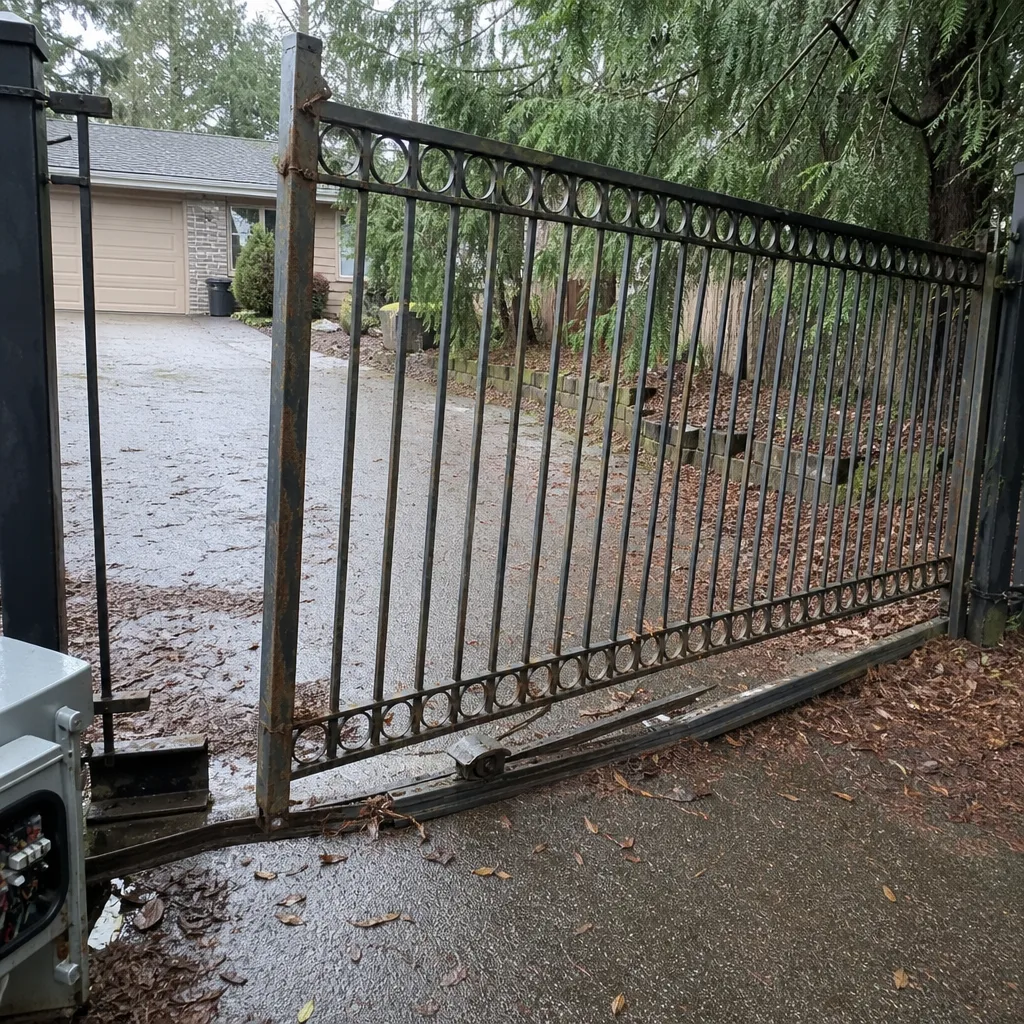 Before
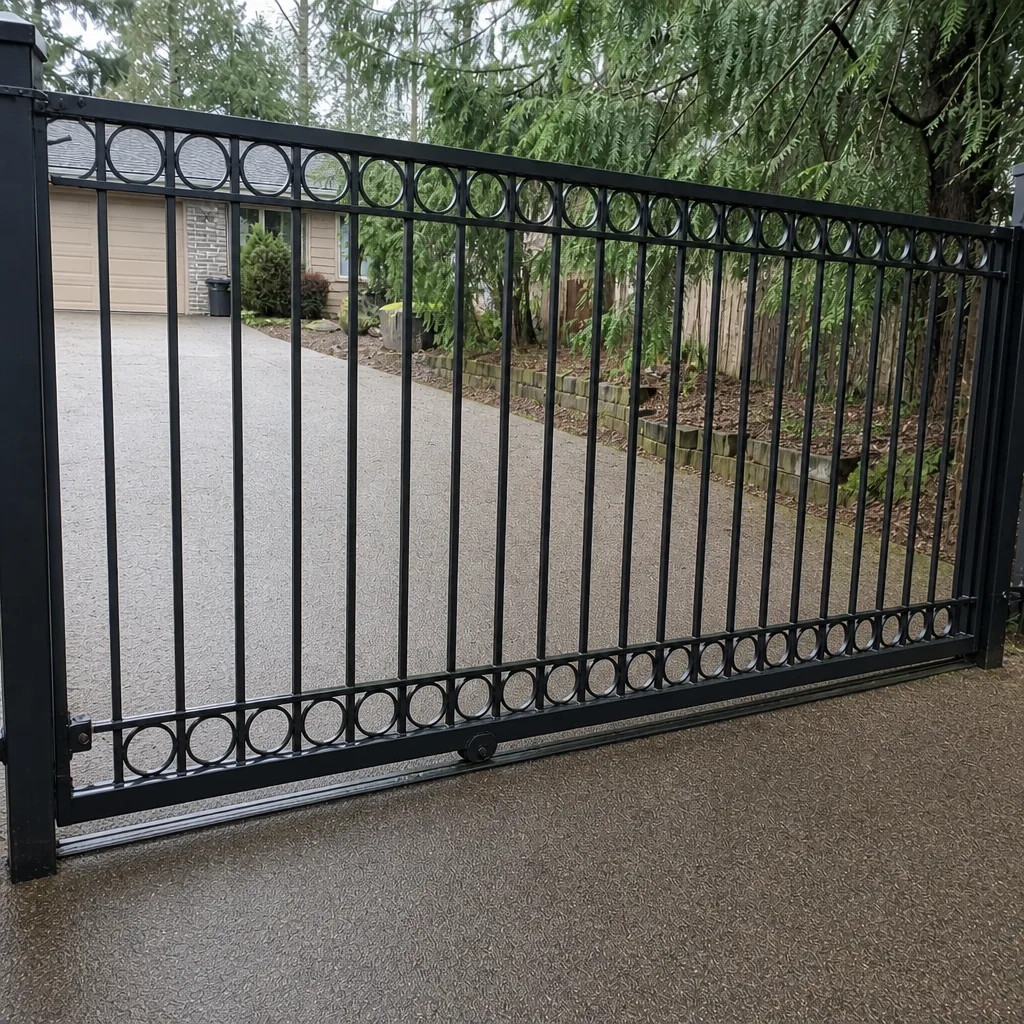 After
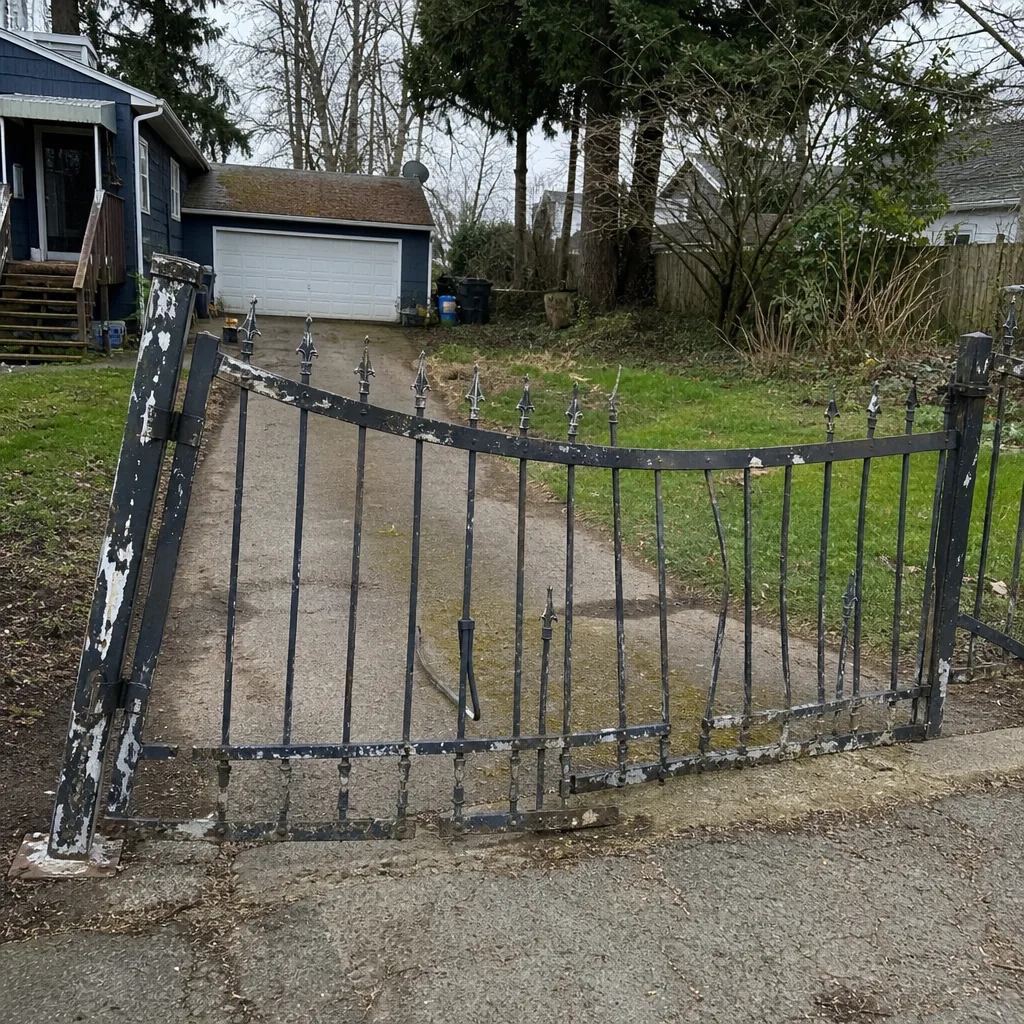 Before
 After
 Before
 After
When to Call a Professional
Call a professional when the failure is electrical, when the controller is misbehaving, when a safety device has been triggered or damaged, when a post is leaning or a slide gate has left its track, and when the operator is under warranty and the repair would require opening it. Also call when you’ve tried the obvious mechanical fixes and the gate still isn’t right – that’s usually a sign the fault was never mechanical. Our technicians have up to 8 years of experience diagnosing exactly these cases, and we’ve seen how quickly a “quick look inside the enclosure” turns into a bigger repair. A free estimate gives you a clear picture of what needs to happen before anyone spends money. Gate Repair Renton offers free estimates in Renton – call (866) 293-5161. We answer 24/7. Fast dispatch from 7am to 7pm, Sunday through Friday.
Frequently Asked Questions
Sometimes, but only the mechanical side. If your gate’s issue is a loose hinge, a roller, debris in a track, or a latch, DIY is often reasonable. If the operator itself won’t respond, misbehaves, or the control board is involved, a professional diagnostic is the safer and usually cheaper path. Call (866) 293-5161 for a free estimate.
It can. Opening a sealed operator enclosure, replacing a board without authorization, performing a factory reset, or cutting operator wiring are the interventions most likely to void coverage. If your operator is still under warranty and the repair requires opening it, have a technician do the work. Estimates are free.
UL 325 is the safety standard for automated gate operators, and it requires safety reversing: the gate must detect an obstruction and reverse or stop. Modifying a safety device and getting it slightly wrong creates a real injury risk if the gate later fails to detect someone. That’s a liability question, not just a repair question. Call us to have safety-system work done properly.
Moisture drives corrosion on connectors, swelling in wooden frames, and rust in steel hardware. A gate that behaves differently after rain usually has an electrical fault rather than a mechanical one, which means a diagnostic rather than a reset. Our electric gate repair service handles these cases regularly.
We can narrow down what’s likely happened based on the symptom, but we won’t walk you through an electrical repair or safety device configuration over the phone. Those need to happen on-site. Call (866) 293-5161. We answer 24/7. Fast dispatch from 7am to 7pm, Sunday through Friday.
A diagnostic includes a visual inspection of the gate’s mechanical condition, a check of the power supply and operator wiring, a review of the control board and its stored configuration, and testing of all safety devices. That’s how the failure gets traced to the right category before any repair is quoted. Call (866) 293-5161 for a free estimate.
The Bottom Line
DIY is the right call for mechanical gate problems you can see and reach, and the wrong call for anything on the electrical or operator side. The dividing line is failure type, not confidence. Mechanical repairs that go slightly wrong cost time; electrical attempts that go wrong can cost a board, a reprogram, or a warranty. When you’re not sure which side you’re on, a free estimate from a specialist who already knows your operator brand is the cheaper way to find out. Call (866) 293-5161. We answer 24/7. Fast dispatch from 7am to 7pm, Sunday through Friday.
Written by the team at Gate Repair Renton.